How Drone Spreading Solutions Are Transforming UK Farms
Why Farmers Are Turning to Drones for Spreading
Walk onto any arable farm in the UK during spring, and you will see the same old rhythm: tractors crawling across fields, spreading fertiliser or seed with a broad, uneven hand. It works, but it is not precise. It compacts soil, burns diesel, and leaves some parts of the field overfed while others go hungry. That is where drone spreading solutions have started to change the game, and quietly, without the hype you might expect from a piece of agri-tech.
I have been involved in precision agriculture for over a decade, and I remember the first time I watched a DJI Agras T50 working a field of winter wheat. The operator stood on the headland, tablet in hand, while the drone moved in a grid pattern that looked almost surgical. What struck me was not the novelty but the reduction in waste. The drone was placing nitrogen exactly where the crop needed it, using GPS guidance and RTK positioning to stay within centimetres of its line. That level of accuracy is simply not possible with a tractor and spinner.
The Practical Edge of Aerial Spreading
The key advantage of drone spreading solutions is not speed in raw terms - a tractor can cover more hectares in a day. It is access and precision. After heavy rain, when ground is wet, a tractor will rut the soil and damage the crop. A drone flies over, leaving no footprint. That alone has made a difference on farms in the west of England, where clay soils stay wet late into spring. On those farms, the choice is often between spreading late or not spreading at all. With an agricultural drone, you can fly the day after rain and get the job done.
There is also the matter of variable rate application. With a conventional spreader, you set a rate and hope it holds. With a drone - especially models like the XAG P100 Pro or the older Yamaha RMAX - you can load a prescription map and adjust the rate on the fly. The drone reads the map, applies more fertiliser where the crop is thin, less where it is thick, and saves money on inputs while keeping yield potential high. I have seen farms reduce nitrogen use by fifteen percent in a season simply by switching to variable rate aerial spreading.
Beyond Fertiliser: Seeds and Pests
Fertiliser is only part of the picture. Seed broadcast from a drone has become a serious option for cover crops and grass re-seeds. The spread pattern from a well-calibrated drone is more consistent than a trailed spinner, and you can put seed into standing crops without driving over them. On one farm in Lincolnshire, the agronomist used a drone to broadcast a cover crop mix into ripening wheat, gaining three weeks of establishment time compared to waiting for the combine. That extra growing window matters when you are trying to hit a regulatory deadline for soil cover under DEFRA schemes.
Pest and disease control also benefits. Copper fungicide for potato blight, for example, can be applied with a drone in conditions that would keep a sprayer out of the field. The drone flies low and slow, and the rotors help push the spray into the canopy. It is not a replacement for a full ground rig on large acreage, but for spot treatments, headlands, and steep slopes, it is hard to beat. The HSE and the Civil Aviation Authority have set clear rules for drone use, including the need for a permission for commercial operations and a minimum distance from people and property. Any operator working under those rules knows the value of planning a flight path as carefully as you would plan a spray round.
Regulation and Training
Speaking of rules, it is worth understanding the regulatory side before you buy a drone and a spreader module. The Civil Aviation Authority requires anyone flying a drone for commercial purposes to hold a valid operational authorisation. That is not optional. For agricultural use, you also need to be aware of DEFRA guidelines on pesticide application, and if you are handling chemicals, you will need the relevant BASIS and NRoSO qualifications. The days of strapping a hopper to a hobby drone and hoping for the best are long gone, and rightly so. The equipment is capable of applying hundreds of kilograms of material per hour, and the consequences of a mistake - drift, over-application, or a flyaway - are serious.
Training and certification are not just regulatory hurdles. They improve the quality of the work. A trained operator understands how to calibrate the spread pattern, how to adjust for wind, and how to use RTK positioning to avoid gaps and overlaps. Without that knowledge, you are flying blind. The best operators I have met treat their drone like a piece of farm machinery, not a toy. They check the LiDAR data on field topography before they fly, they do soil sampling to build accurate prescription maps, and they log every flight for traceability.
Choosing the Right Equipment
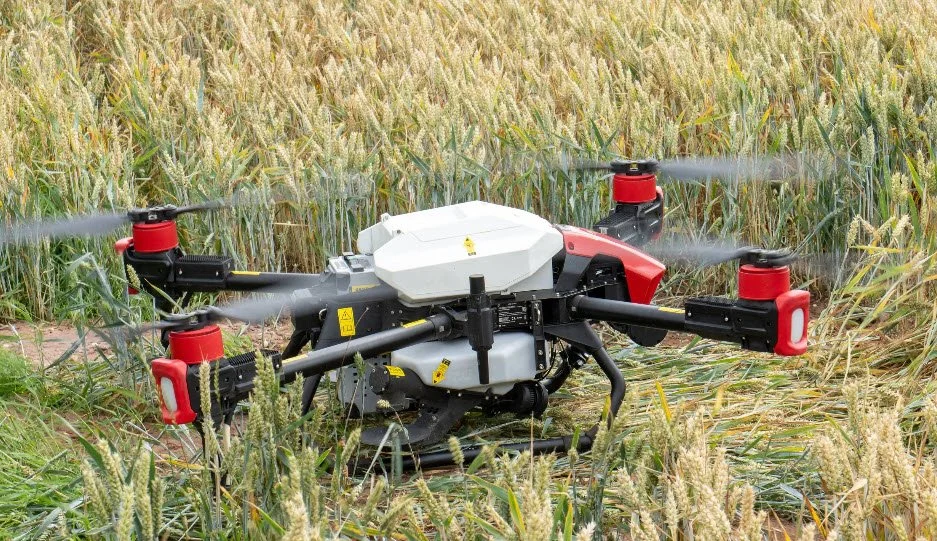
Not all drones are equal when it comes to spreading. The DJI Agras T50 is the current workhorse, with a large hopper and a spreading system that handles fertiliser, seed, and slug pellets with the same consistency. It is a heavy machine, and it needs a decent battery setup, but it is built for farm work. The XAG P100 Pro offers similar capacity with a slightly different control philosophy, and it has a strong following among operators who prefer its ground station software. The Yamaha RMAX is older and less common in the UK now, but it still appears on some large estates that have been using it for years. The choice often comes down to local dealer support and the type of material you plan to spread most often.
One thing I have learned from talking to agronomists and operators is that the spreader itself matters as much as the drone. A poor spread pattern wastes product and creates uneven growth. Good drone spreading solutions use a disc or auger mechanism that meters the material precisely, and the best ones allow you to adjust the spread width from the controller. That flexibility is useful when you are working odd-shaped fields or headlands near watercourses.
Real Returns on Investment
The question of cost comes up every time I mention drones to a farmer. A complete system with a drone, batteries, charger, spreader, and RTK base station runs into five figures. That is not pocket change. But if you are spreading a thousand hectares of fertiliser and seed each year, the savings in material alone can cover the cost within two seasons. Add in the ability to apply when ground conditions are marginal, and the benefit to soil structure from reduced compaction, and the case becomes stronger.
There is also a growing market for contract spreading. Several firms in the UK now offer drone spreading solutions as a service, and their books are full during the spring and autumn windows. For a farmer who does not want to own the kit, hiring a contractor is a practical way to access the technology without the capital outlay. I have seen contractors charge by the hectare, and the price is competitive with ground-based spreading once you factor in the reduced damage to the crop and soil.
Looking Ahead
The technology is still evolving. Batteries get better every year, and the integration with farm management software is improving. I expect to see more automatic flight planning based on LiDAR surveys and soil sampling data, where the drone not only spreads but also maps the field as it goes, feeding data back into the next season's prescription. That closed loop - survey, plan, apply, measure - is the real promise of precision agriculture, and drones are a critical part of it.
For now, the practical message is simple: if you farm in the UK and you have not looked at drone spreading, it is worth a conversation. The regulations are clear, the equipment is proven, and the results on yield and input efficiency are hard to ignore. Start with a contractor, get a demo on your own fields, and see whether it fits. For many farms, it already does.